
Should Kids Learn Coding Before Algebra?
Mathematics and programming are inseparable. Programming itself requires the use of many mathematical concepts, such as logical operations, geometric figures, algebraic formulas, etc. But this does not mean that you must fully master mathematics before you can start learning programming. On the contrary, programming can help children better understand and apply mathematical knowledge in practice. Regarding whether children should learn programming before learning algebra, there is currently no unified conclusion. Different opinions are based on factors such as educational goals, cognitive development, and resource allocation. Parents and teachers should pay attention to individual differences and avoid blindly following trends. Prioritize observing children's interests, concentration, and mathematical abilities, for example, by assessing adaptability through logic games or simple programming tasks; when resources are limited, prioritize ensuring a solid foundation in mathematics before expanding to programming, as algebra is a universal tool for most subjects, while programming can be supplemented later; the ultimate goal should be to cultivate holistic thinking, rather than a sequence of single skills.

Each age group
Early childhood stage (3-5 years old):
- Mathematics: At this stage, children's mathematical interest and basic concepts can be cultivated through games and small activities in daily life, such as counting, recognizing shapes and colors.
- Programming: Children can be exposed to programming ideas through simple logical games and graphical programming tools (such as Scratch Jr.) to cultivate their logical thinking.
Primary school stage (6-12 years old):
- Mathematics: Continue to consolidate the foundation and learn basic addition, subtraction, multiplication, division, fractions, decimals, geometry and other knowledge.
- Programming: You can gradually go deeper and learn more complex programming tools and languages (such as Scratch, Python), and stimulate children's interest and creativity through projects and games.
Junior high school and above (13 years old and above):
- Mathematics: Enter more advanced mathematical knowledge, such as algebra, geometry, probability and statistics.
- Programming: You can start learning more professional programming languages (such as Java, C++), develop more complex projects, and even participate in programming competitions and practical application development.
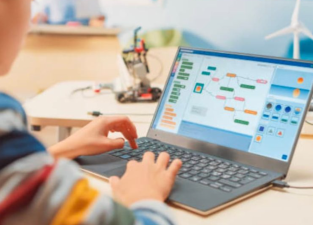
How programming promotes mathematical learning
Programming can promote mathematical learning in the following ways:
- Visually display mathematical concepts: By writing programs, children can intuitively see how mathematical formulas and concepts work in practical applications.
- Solve practical problems: Programming allows children to apply mathematical knowledge to solve practical problems and improve their mathematical application ability.
- Enhance logical thinking: Logical thinking training in programming can help children perform better in mathematical reasoning and problem solving.
Choose appropriate learning methods
- Mathematics learning: Make mathematical learning interesting and vivid through games, interactive exercises, physical operations, etc.
- Programming learning: Choose graphical programming tools and interesting projects to allow children to master programming skills in practice while improving their understanding of mathematics.
Summary
-
 Education
Should schools teach financial literacy?
With the globalization of the economy and the complexity of the financial market, the importance of financial knowledge has become increasingly prominent. However, most people currently have very limited knowledge of basic financial knowledge, their personal financial management capabilities are generally weak, and there are even many investment fraud cases, which have caused considerable losses to individuals and society. Therefore, improving the financial literacy of the whole people, popularizing financial education, and cultivating the awareness of financial management of the whole people have become urgent issues to be solved.
-
 Education
Hybrid learning models are rising
In the "Internet +" era, the traditional face-to-face one-way transmission teaching model of schools can no longer meet the needs of students in the digital age. With the sound of the future school fantasy, blended learning (Blended Learning) that combines the advantages of traditional classrooms and online learning is gradually becoming the mainstream teaching organization method.
-
 Education
Mental Health Is Now Part of the Curriculum
In recent years, adolescent mental health issues have frequently become the focus of social attention. From school bullying to academic pressure, from parent-child conflicts to social anxiety, children's psychological distress is becoming increasingly complex and younger.The mental health problems of adolescents have attracted strong social attention in recent years. It is essential to leverage the main channel of classroom teaching, accelerate the development of mental health courses, and enable students to master mental health knowledge and skills. Increase publicity and education efforts, popularize mental health knowledge, adhere to the combination of education and service, and view mental health issues scientifically and rationally, fostering students' awareness of self-help, mutual assistance, and seeking help. Increase investment and improve the professional level of school mental health education and service teams; not only should the number of practitioners be increased, but their training and continuing education should also be strengthened.